Cama Athornan manuscript repository
As part of the MUYA project some 42 Zoroastrian manuscripts have been catalogued and digitised at the Cama Athornan Institute and are now fully accessible in this repository. They include material written in Avestan, Gujarati, New Persian, Pahlavi and Pazand. The little-known crown jewel of this collection, which includes codices from both India and Iran, is without doubt the Pahlavi codex DH (after Dastur Hoshang) containing the text of the Iranian Bundahišn, the Zand ī Wahman Yasn and sections of the Dēnkard. The Cama Athornan collection also comprises numerous manuscripts of the Yasna, Vīsperad, Vīdēvdād and the Khorde Avesta.
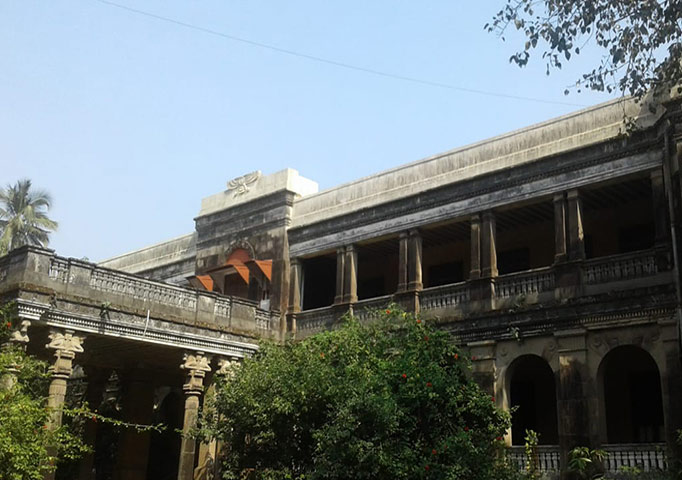
M. F. Cama Athornan Institute (MFCAI), Mumbai, India
The M. F. Cama Athornan Institute (MFCAI) is a training school for Zoroastrian priests founded in 1923 by Meherwanji Muncherji Cama, and named in memory of his father Muncherji Faramji Cama.
The Multimedia Yasna (MUYA)
The Multimedia Yasna project, which is based at SOAS, University of London is funded by the European Research Council (ERC) with an Advanced Investigator Grant (2016-2022) to Professor Almut Hintze. MUYA is a multi-disciplinary, international project which had as its focus the Yasna – the core ritual of the Zoroastrian religion.
The ground-breaking nature of MUYA lies in the fact that it combines two different, yet complementary approaches: one starts from the act of ritual performance, while the other proceeds from manuscripts. In this two-pronged approach, the Yasna has been studied both as an event in the form of ritual performance and as a text in the form of a literary document. The two procedures are integrated to address questions about the meaning and function of the Yasna in a historical perspective. Both approaches employ digital methods and enable all of the outputs of the project to be delivered online.
The Multimedia Yasna (MUYA)